
The memo says AI. The headcount says the rest.
Airbnb says AI now writes 60% of its code. Meta says AI is why 8,000 people are leaving. Both are announcements. Only one of them costs the company something to make.
The top ten stocks are now a record share of the S&P 500, and every passive fund that tracks it is an unhedged bet on the AI trade. The mechanism that carried it up has no brakes on the way down.
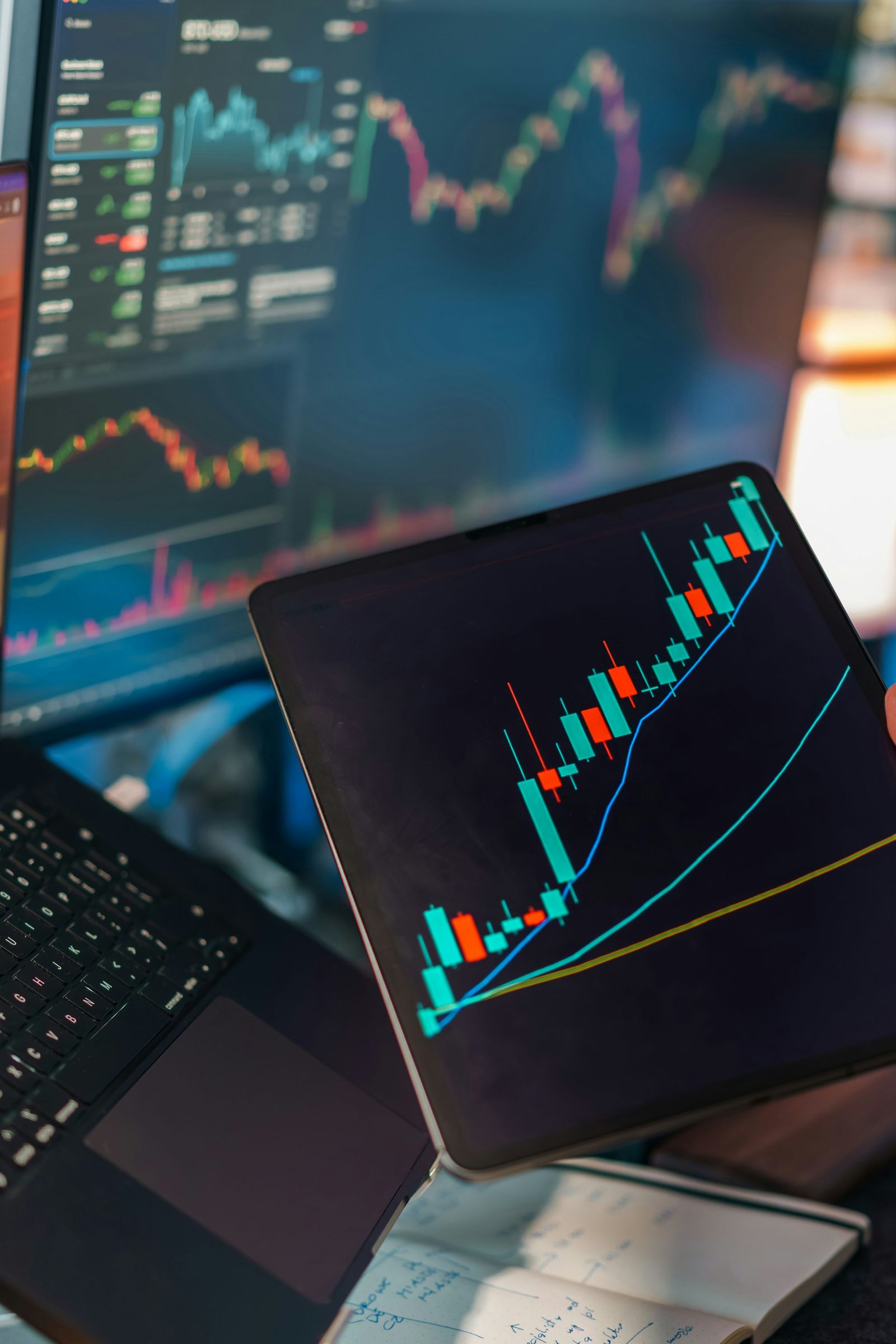
Photograph: Jakub Żerdzicki / Unsplash
The number everyone repeats is 40 percent. The top ten companies in the S&P 500 now account for more than two-fifths of its market value — a record, by a comfortable margin over the dot-com peak that older traders keep invoking as a warning. It is a clean, quotable figure, and like most clean figures it gets recited far more often than it gets interrogated. The more important number is the one it buries: how little of the index is doing the work, and how completely the so-called safe default has become a concentrated bet on a single story.
Strip the headline back and the arithmetic is stark. Nvidia alone is roughly 7 percent of the index. Apple is around 6 percent, Microsoft near 5. Three names — three balance sheets, three execution stories — are something close to 18 percent of a $57 trillion index. The Magnificent Seven together are about 35 percent of the S&P 500, up from a low-20s share at the start of the decade. To own the index is to own that. There is no version of the passive trade that opts out.
Concentration is the risk that compounds quietly and arrives all at once. For most of the post-2008 era, the case for index funds was that they spread your money across the whole American corporate economy and let you stop guessing which manager was lucky. That case rested on breadth. Breadth is precisely what has eroded. The ten largest companies have gone from about 22 percent of the index in 2020 to just shy of 40 percent today, and the move was not gradual sentiment drifting higher — it was a handful of AI-adjacent franchises repricing the whole tape.
The crossover that makes this matter is that passive is no longer the minority sport it was when these arguments started. Index funds and ETFs now hold roughly 60 percent of US equity fund assets; the moment passive assets overtook active arrived in 2024 and the gap has only widened. So the largest pool of capital in the market is, by design, indifferent to what any of these companies is actually worth. It buys in proportion to size, and the biggest names are big precisely because they have been bought. That is a loop, not a valuation.
The same mechanism that carried the index up on the way in has no brakes on the way out, because the buyers and the believers are the same people.
Here is how the money actually moves, and why the downside is structural rather than a matter of nerves. A market-cap-weighted index allocates new money to a stock in proportion to that stock's existing weight. When a name rises, its weight rises, and the next dollar into every fund that tracks the index buys more of it — not because anyone decided it was cheap, but because the rules say so. On the way up this is a tailwind that looks like vindication. Flows chase weight, weight chases price, price chases flows.
Run the same loop in reverse and you find the problem. If one of these names slips — a guidance miss, a capex write-down, a regulator with a long memory — its weight falls, and the mechanical rebalancing that fed it on the way in now sells it on the way out, across every fund at once, to the same set of holders. There is no marginal value buyer waiting underneath, because the marginal buyer for years has been a passive vehicle that does not form a view on price. The bid that held the thing up was never conviction. It was flow. Flow reverses.
This is what practitioners mean when they call the index a single point of failure. The phrase is Torsten Slok's at Apollo, and it is not rhetorical. When 40 percent of the index sits in ten correlated names, and a large share of those names are levered to one capital cycle, the diversification the index is supposed to provide is partly an illusion. You hold 500 companies and perhaps a dozen exposures.
None of this is a claim that Nvidia, Microsoft or Apple are bad companies. They are extraordinary businesses with real cash flows, and that is exactly the confusion worth naming. A trade can be a great company and a dangerous position at the same time. The question for an index holder is never whether the company is good. It is whether the price already assumes the company stays good for a very long time — and what breaks if that assumption is even slightly early.
The assumption is heroic by construction. The hyperscalers driving this — Microsoft, Alphabet, Amazon, Meta, Oracle — are now spending a record share of their operating cash flow on AI infrastructure, with the index's IT sector accounting for an outsized slice of total capex. That spending is a bet that demand for compute keeps compounding fast enough to earn a return on hundreds of billions of dollars of data-centre buildout. It may. But it means the index's largest weights are not defensive cash machines coasting on installed bases; they are companies in the most capital-intensive phase of their lives, with the return on that capital still unproven at this scale.
The return-contribution figures show how much rides on it. Something like 42 percent of the S&P 500's total return in 2025 came from the Magnificent Seven. That is the tell. When a third of the index produces more than two-fifths of the gains, the other 490 names are not diversification — they are ballast. Leadership this narrow can mask weakness underneath for a long time, and then it can amplify the drawdown when it goes, because there is nothing built to catch it.
What is priced in is continuation: that AI demand stays vertical, that the capex earns its return on something like the assumed timeline, that the largest names defend their margins against each other and against whatever comes next. What is merely hoped is that this can keep happening without a pause long enough to make the weights look heavy. Markets do not usually grant that. The history the older traders keep invoking — the early 1970s, the dot-com top — is not a forecast of when, but a reminder that concentration at these levels has unwound before, and that it unwinds through exactly the index everyone holds as the cautious choice.
There are ways to hedge the structure rather than the names. Equal-weight versions of the same index cut the top exposures from a third of the portfolio to a couple of percent; active managers have spent the cycle underweight the Mag-7 by several hundred basis points, mostly to their cost so far. Both are bets that breadth returns. Neither is free, and both have underperformed the cap-weighted index for years, which is precisely why so few investors hold them now. The crowd is in the cap-weighted trade because it has worked. That is the most concentrated position of all.
So the question to sit with is not whether these companies deserve their valuations. It is what your supposedly diversified default fund is actually long, and what happens to it if three names you have never chosen, and cannot sell out of without selling everything, stop growing into expectations that are already priced for perfection. The index has quietly become the trade. The downside nobody is pricing is that the safe option and the speculative one are now the same position.
Airbnb says AI now writes 60% of its code. Meta says AI is why 8,000 people are leaving. Both are announcements. Only one of them costs the company something to make.

Companies are announcing record AI conviction and cutting staff the same week. The press release describes ambition. The WARN notice describes the trade-off ambition required. Only one of them is under oath.

The AI build-out is being financed by the same handful of companies buying from each other. The mechanism is elegant. The exposure is the part no one wants to price.